What Every Producer Should Know About a Calcium Carbonate Grinding Plant
Getting into GCC production without a clear understanding of how a calcium carbonate grinding plant actually functions is one of the fastest ways to waste significant capital. The plant looks like a collection of heavy machines, but it's really a carefully sequenced system where material properties, equipment specifications, and process parameters must align precisely to produce consistent, market-ready powder. Producers who understand this going in make better equipment decisions, avoid costly reconfigurations, and reach stable commercial output much faster.Calcium carbonate processing begins with raw limestone, calcite, or marble and ends with precisely specified ground calcium carbonate powder or ultra-fine slurry. Between those two points lies a sequence of crushing, grinding, classification, optional coating, and packaging stages that collectively determine the product quality your customers experience and the profitability your business generates. Every stage matters. None of them is optional as a design consideration even if surface coating is optional as a process step.
Why Does the Crushing Stage Matter More Than Most Producers Think?
Many producers underestimate the crushing section's importance because it seems like the simplest part of the plant. It's not simple at all. Jaw crushers handle primary size reduction of large raw material blocks, converting quarry-sized limestone into manageable fragments. Hammer crushers follow with secondary reduction, bringing material to the specific feed size that grinding mills need for stable, efficient operation.
The output characteristics of the crushing section directly determine how well your grinding mills perform. If crushed material contains too many oversized pieces, the mill feed becomes erratic and grinding efficiency drops. If the crushing generates too many fines, classification becomes more difficult and product yield suffers. A well-designed crushing section produces consistently sized output that maximizes mill utilization, minimizes energy consumption per ton of product, and supports stable particle size distribution in the final powder.
How Does Calcium Carbonate Processing Flow Through the Grinding Stage?
Calcium carbonate processing through the grinding stage is where fineness is established and where your product's market position is determined. Different grinding mills produce different achievable fineness ranges, and selecting the right one for your target applications is the central technical decision in plant design.
For construction-grade coarse powder at 325 to 800 mesh, Raymond mills provide reliable and cost-effective processing. For medium-fine powder at 1250 to 2500 mesh targeting plastics, coatings, and paper, ball mills with classifiers, ring roller mills, or vertical mills are the standard choices. For ultrafine powder above 3000 mesh serving premium markets, precision ball mill and classifier configurations with surface coating integration are necessary.
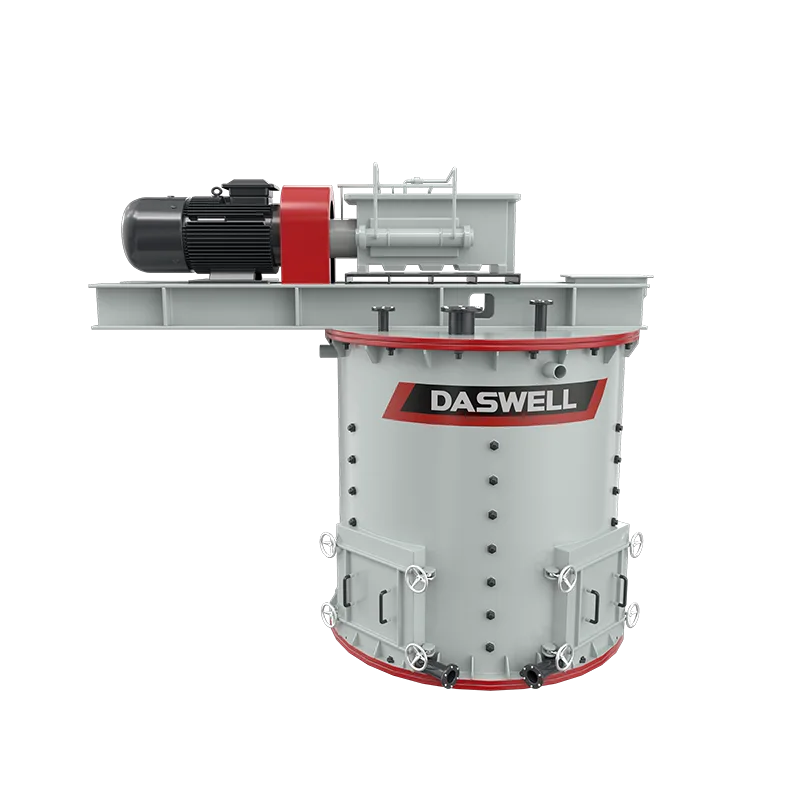
The calcium carbonate grinding plant solutions from Daswell Powder match grinding mill selection to each client's specific fineness targets, raw material properties, and production capacity requirements. This customized approach ensures the grinding stage consistently delivers the particle size distribution that target markets demand.
What Makes Air Classification So Valuable in GCC Processing?
Air classification is the quality control mechanism of the entire processing line. After grinding, material passes through a high-efficiency turbo classifier that separates fine powder meeting the particle size specification from oversized particles that need further grinding. The oversized material automatically returns to the grinding circuit, creating a closed-loop system that continuously processes material until it meets specification.
This closed-loop design has a significant practical impact on product consistency. Every batch of powder leaving the classifier has met the same particle size criterion. There's no variation caused by mill wear changes, feed rate fluctuations, or raw material hardness differences. The classifier compensates for these normal operational variables and maintains consistent product quality across long production runs.
In the absence of proper classification, particle size distribution widens. In plastics, wider distribution leads to surface defects and reduced mechanical properties. In coatings, it causes film thickness variation and poor coverage. In paper coating, it disrupts print quality. Classification isn't optional in serious GCC production. It's fundamental to the commercial value of the product.
What Are the Benefits of Integrated Surface Coating?
Surface coating converts standard calcium carbonate into a functionalized material that commands significantly higher commercial value. During coating, qualified fine powder enters a coating machine where stearic acid or silane is applied under precisely controlled temperature and mechanical mixing conditions. The coating agent forms a uniform molecular layer on each particle's surface, changing the surface chemistry from hydrophilic to hydrophobic.
This transformation matters enormously in plastics applications. Hydrophobic coated calcium carbonate disperses uniformly in polymer melts, improves tensile and impact properties, allows higher filler loading ratios, and produces better surface finishes in molded products. Uncoated calcium carbonate tends to agglomerate in polymer matrices, creating quality problems that plastic manufacturers quickly trace back to filler performance.
For GCC producers, offering coated powder opens the door to premium market segments with substantially better margins. The coating machinery investment pays back quickly through higher product pricing and access to customers who specifically require surface-modified calcium carbonate for their formulations.
The complete calcium carbonate processing systems from Daswell Powder include coating machines as an integrated option within the full production line, ensuring that coating quality is consistent and that the operational transition between uncoated and coated product grades is efficient.
Why Does Automated Packaging Complete the Value Chain?
Packaging is the final stage of calcium carbonate processing and the point where the product transitions from industrial material to commercial commodity ready for sale and shipment. Industrial powder packaging machines in modern GCC plants handle the filling, weighing, and sealing of bags at high throughput with consistent accuracy and minimal dust generation.
Consistent bag weight is a commercial necessity. Weight variation leads to customer complaints, commercial disputes, and reputational damage that's difficult to recover from. Clean filling with low dust generation is both an environmental compliance requirement and a product quality indicator. High throughput packaging prevents this section from becoming the bottleneck that limits overall plant output.
For plants producing multiple product grades across different bag formats and sizes, flexible packaging systems that can adapt between product types without lengthy changeover times add meaningful operational value. Daswell Powder's powder packaging machines are integrated within the full production line as standard equipment, ensuring that packaging performance matches the capacity of every upstream processing stage.
Conclusion
A calcium carbonate grinding plant is a precisely engineered system where every stage contributes to the quality and value of the final product. Understanding the function and importance of each processing stage, from crushing through packaging, equips producers to make better equipment decisions, serve more valuable market segments, and build GCC operations that deliver consistent results over the long term. The difference between a plant that struggles and one that thrives usually comes down to how well the initial design aligned with real raw material properties, target fineness requirements, and the specific demands of the markets the producer intends to serve.
FAQ
Q: What is the main function of a calcium carbonate grinding plant? A: It converts raw limestone, calcite, or marble into precisely specified ground calcium carbonate powder through controlled crushing, grinding, classification, and packaging stages.
Q: How does calcium carbonate processing achieve consistent particle size? A: Air classifiers create a closed-loop system that returns oversized particles to the grinding circuit until all product meets the specified particle size distribution.
Q: What fineness can a calcium carbonate grinding plant produce? A: Depending on mill configuration, GCC grinding plants produce powder from 325 mesh coarse grades through 3000 mesh ultrafine grades for specialty applications.